

Posted: March 20th, 2025
6 Marketing Scams Targeting Small Businesses + How to Avoid Them
It’s tough being a small business. Many times, small business owners have to wear multiple hats that may not be their expertise. You might be a certified expert in your field, but you may not know about the ins and outs of marketing.
As a small business owner myself, I really detest individuals and companies who operate in such a way that take advantage of other small businesses. Even if a business may technically be operating legally, they may not be operating ethically. I’m continually on the lookout for these sorts of things, alert my own clients to them and generally try and get the word out to other businesses on what to look out for.
Why are small businesses a target?
Scammers often target small businesses to unethically charge money with no real ROI (return on investment).
The top reasons why small businesses are targets include:
- The average small business owner may be unfamiliar with how marketing services work or generally have a gap in knowledge that can be exploited.
- They know small business owners are typically busy and do not have a long chain of command to get to a decision-maker.
- They take full advantage of fear, tricking owners to believe that their business might already be damaged or will be if they do not hire them to fix it.
Awareness and education are critical to fighting against these sorts of scams.
What can the effects to your business be?
Once compromised, a company can suffer from disastrous effects, from loss of money to reputation damage. You can avoid these scams by staying up-to-date about their tactics and looking out for red flags and warning signs.
Here Are 6 Common Marketing Scams to Look Out For
- Google Business listing telemarketing calls and text messages
- Promises to rank #1 on Google
- Domain name payment requests
- Marketing and web design services
- Requests to pay via credit card
- Vanity awards
1. Google Business Listing Telephone Calls
One of the top scams I have observed targeting small businesses comes in the form of phone calls and sometimes even text messages. With calls, they may be robocalls (recordings) or live people but they’ll typically state one of two things:
- There is a problem with your Google business listing or it’s not “verified”.
- You must “take action” or your Google business listing will be removed.
The person may also claim to work for Google or be “from” Google.
HOW TO TELL IT’S A SCAM
The important take-away is that Google does not call businesses in this manner. They state on their support website that:
“Google does not make unsolicited sales calls from an automated system. However, we may place automated phone calls to your business, as a service to Google users, for non-sales tasks like making reservations or confirming your business hours.”
For example, if you choose phone verification when you set up your Google business listing, you will receive an automated call from Google. Additionally, there is no charge to set up a Google Business™ listing.
It’s also worthy to note that similar scams now exist. I recently received a robocall stating, “Your company is not registered with Amazon Alexa Voice Services.”
This is very similar to the Google listing scam in that the message attempts to create fear. They want you to doubt that your business is “missing out” and could be gaining new customers. You are then prompted to speak with a representative.
2. Promises to Rank #1 on Google and Other SEO (Search Engine Optimization) Scams
Search engine optimization (SEO), when done properly and ethically, can help your business website be seen by your target audience. Like most marketing activities, it is very hard to guarantee certain results though.
When a company promises gratuitous results, such as making your website #1 on Google, it’s likely a scam.
Other SEO-related scams can include:
- Guaranteed traffic (which is typically fake, a bot, or not targeted).
- The use of “proprietary” technology that will get you better search engine rankings over the competition.
- Buying of “backlinks”.
- A claim to “know someone” or have a “connection” with Google.
- A generic email claiming that your website SEO can be “improved”.
These companies can be very convincing with “evidence” such as screenshots of No. 1 rankings, “testimonials” from past clients, and lofty guarantees–all of which are very easy to fake.
HOW TO TELL IT’S A SCAM
This may be the easiest one to spot on the list but also one that small businesses continually fall victim to.
Scammers can be very convincing, and small business owners might lack knowledge of how legitimate SEO works.
The biggest tip-off is that these are always cold solicitations, typically through email. They often contain no personalization or inaccurate information about your business as well as spelling or grammar errors. Usually, they do not disclose their company information or only use a Gmail address.
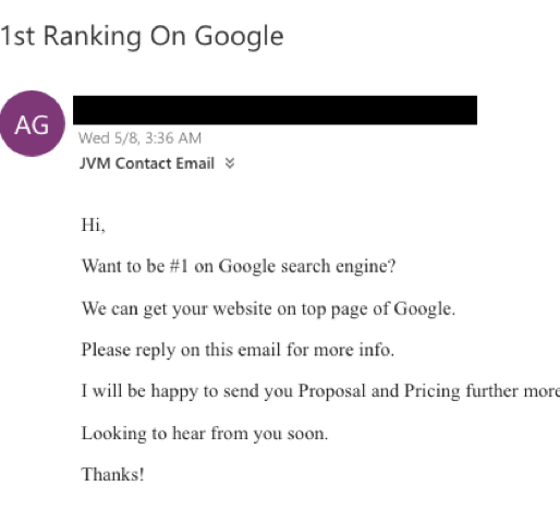
Even if a solicitation passes those red flags, guaranteed placement (such as “#1 on Google”) or traffic, “proprietary” technology, or claims to have “insider information” from Google should immediately signal that it is a scam.
3. Website Domain Name Payment or Renewal Requests
Domain name scams are one of the oldest tricks on this list. I remember receiving snail mail letters like the one below as far back as 10+ years ago.
Unscrupulous domain companies will typically target small business owners with a snail mail solicitations. In a typical letter, the scammer makes it appear that your domain name is expiring and it’s designed to look like a payment form, like you’d get from other bills.

While the letter might look official, it’s really a scam.
The solicitation is almost always laid out like an invoice. The reason it has perpetuated for so many years is that busy small business owners are tricked into thinking it’s a legitimate bill and simply pay it.
I have had actual clients of mine fall for this when the scam first came about. The result was not only a fee that was many times the rate of a regular domain registration, but also an authorization to transfer their domain to this other company and away from their original registrar.
Once transferred, their website would also go down, and it was a difficult process to re-transfer the domain.
HOW TO TELL IT’S A SCAM
First, if it comes from Domain Registry of America, that is your number one tip-off. This company has been unethically tricking customers into payment and transfer of domains for years. Sadly, it is not the only one.
Here are other ways to spot this type of scam:
- Know who your domain registrar actually is—if the solicitation isn’t from that company, it’s a scam.
- Know when your domain actually expires/renews again—often these types of scams have false information about when your domain is expiring.
- The notice looks like an invoice, but somewhere on it, the text says that it is not actually a bill.
- The notice claims another company is trying to “use” your name and suggests purchasing multiple other (often foreign) domains.
By looking for these red flags, you can avoid accidentally switching over your domain and losing out on money.
4. Marketing and Web Design Services
As someone who does reputable web design and marketing, this one is really offensive to me. One company in particular seems to be notorious for targeting small businesses and taking advantage of the fact the owners are usually busy and don’t know what this type of service typically takes or costs.
Originally started by the Yellow Pages directory publisher, I believe this particular company came into being when sales started declining in the original directory to take advantage of more online advertising. It’s since changed hands, but one tactic remains the same–they have sales representatives in many areas who physically go into local businesses to sell them on these services. They also use cold calling techniques to reach businesses.
Their main tactic is to get businesses to sign a contract for marketing services. When companies start to notice that they are paying a lot of money monthly and not seeing serious benefits to their business, they find they can not get out of these contracts.
So this one, which technically not a scam, operates on unethical business practices, so much so that it has had multiple lawsuits for fraudulent misrepresentations and omissions. The internet is littered with reviews of this company overcharging and underdelivering.
Here are some of the things to look out for:
- Local reps visiting your business or cold calling your business with “hard sell” tactics and “all in one” marketing offerings.
- Sales pitches often sound “too good to be true”.
- Contract includes a “Minimum Term” (with hefty fees if you attempt to cancel early).
- Monthly costs can be over $1000.
If you’re unsure where to turn for services like this, I’d start with asking colleagues and peers if they had a recommendation. After that, look for local, reputable companies who specialize in these services and interview them.
5. “Do you accept credit cards?” Quote Requests
One illegal scam that primarily targets service-based businesses involves asking for credit card details. This one seems to target service-based businesses the most. You will receive a quote request by email or text with enough information to potentially be legitimate, but the requester always asks if you accept credit cards.
HOW TO TELL IT’S A SCAM
The very first time I got one of these myself, I had a sneaking suspicion that it was not legitimate. I went to Google and searched, “do you take credit cards scam”, and got pages of results.
Here are top tip-offs to detect this scam before responding to it:
- The email or text is often awkwardly worded with atypical grammar.
- They state that they need whatever your service is (e.g., a landscape project).
- They ask if you accept credit cards.
If you have responded, here are additional tips to identify this scam:
- They are fine with any price you tell them.
- They may ask you what credit card merchant you use.
- They give false information such as names, business names, and addresses.
- They ask for a “favor”, which includes they pay more than what you are asking, and you are to send part of the funds to someone else.
The scammers use stolen credit card information and request that you overcharge the card and send a check to a specific address. Clearly not legitimate. It’s best to not respond to or engage these types of scammers.
6. Vanity Award Scams
There is no question that small business owners are often very proud of their businesses.
Vanity award scams take full advantage of this. The scams typically target small businesses through an email solicitation that their business is the recipient of an award.
Often, the name of the award includes “best of” and the area the business is located in. However, there are a number of variations to this, including being added to an “exclusive” directory rather than receiving an award.
In order to claim this award, a business owner must pay for it. In addition, there is usually a mention of receiving a plaque or trophy as well.
HOW TO TELL IT’S A SCAM
If the solicitation you receive matches the description above, it’s a scam. Also, any award that you are asked to pay for should be a big red flag. Those are typically not legitimate awards.
Small Businesses Can Avoid Scams by Staying Informed
Scammers are masters of illusion. They often do everything they can to pretend to be from or associated with a company you already know, such as Google or the Yellow Pages.
They can spoof phone numbers and also generate websites, documents, and emails. Even text messages can seem very official unless scrutinized carefully.
Before doing business with any company or individual, research them. If you can’t easily verify a company or individual who has contacted you, then there is high potential it might be a scam.
Make sure all of your employees are also trained to spot scams.
Finally, trust your gut instincts. If something doesn’t feel right about it, or if the details just don’t seem to add up, it might be a scam. It’s usually better to err on the side of caution and not respond.
If your business is targeted, remember the tips covered here on how to spot scams. Then consider fighting back and report the scam.
Awareness is your number one defense against these and other types of scams. Educating yourself and any of your employees on how to spot them can ensure that even if you are targeted, your business does not become a victim.